How to Write Accessible Website Content: Tips for Copywriters
Copywriters shape website accessibility more than most people realize. The words in your headings, links, instructions, and buttons determine whether visitors can find what they need and know what to do next.
A designer can build the right structure, but only the copywriter can turn a vague heading into a specific one or decide what a link should promise.
This guide covers the content choices you're most likely to control, along with a few areas like alt text and transcripts, where your job might simply be to flag what's needed for whoever builds the page.
In This Article
How Copywriters Support Website Accessibility
How to write clear website headings
How to write accessible link and button text
How to make website content easier to understand
What copywriters should know about alt text
What to include when a page has video or audio
How Copywriters Support Website Accessibility
Creating accessible website content helps people find, understand, and use the information on a page. It supports people who use screen readers, zoom software, speech input, or other assistive technology. It can also help people with dyslexia or cognitive disabilities, people reading on a small screen, and anyone trying to find an answer quickly.
Website accessibility is a shared responsibility. Designers and developers handle much of the visual presentation and technical structure. Copywriters shape many of the words visitors use to navigate and complete tasks.
A copywriter may be responsible for
Page titles, section headings, and subheadings
Link and button labels
Page organization and paragraph length
Instructions, form guidance, and error messages
Notes about images that carry important information
Introductions and transcript links for video or audio content
When these details are addressed in the initial copy, the person building the page has clearer direction and fewer content problems to solve later.
How to Write Clear Website Headings
Website visitors often scan headings before deciding what to read. Screen reader users can also move from heading to heading to understand the page and locate a specific section.
The copywriter’s job is to write headings that accurately introduce the content that follows. The designer or developer can then apply the correct heading level when the page is built.
A useful heading should be specific enough that someone can understand the section without reading the paragraph beneath it first. It can still match the brand voice, but it should not hide the topic behind a clever phrase.
Less useful: Welcome
More useful: What to Expect at Your First Therapy Appointment
Less useful: The Details
More useful: Wedding Package Pricing and What Is Included
Less useful: Next Steps
More useful: How to Submit Your Grant Application
Writers can also make the intended structure clear in the copy. Identify the page title, main sections, and any subsections so the person building the page does not have to guess which lines are headings.
How to Write Accessible Link & Button Text
Links and buttons should tell visitors where they are going or what will happen when they select them. Labels such as “click here,” “read more,” and “learn more” often rely on nearby text to explain their purpose.
That can become confusing when several similar links appear on the same page. Some screen reader users review a list of links separately from the surrounding paragraphs, and anyone scanning the page may miss the extra context.
Less useful: Learn more
More useful: View Summer Camp Programs
Less useful: Download
More useful: Download the 2026 Event Guide (PDF)
Less useful: Book now
More useful: Schedule a Dental Cleaning
Less useful: Read more
More useful: Read Our Guide to Choosing a Wedding Venue
A short label is fine when it still identifies the action or destination. “Read more” and “learn more” are not automatically inaccessible in every situation, but the copywriter should not assume that hidden technical labels will be added later. Specific visible wording is usually the safer choice.
How to Make Website Content Easier to Understand
Making content easier to understand does not mean removing every specialized term or writing as though every reader is a beginner. It starts with knowing who the page is for.
Know Who You Are Writing For
A page written for patients, parents, or first-time customers may need explanations for terms that are familiar within an industry. A page written specifically for engineers, clinicians, attorneys, or another professional audience may require technical terminology to be accurate and useful.
The goal is not to avoid industry language at all costs. Use the words your intended audience is expected to know, and explain terms when the audience may be unfamiliar with them. For a mixed audience, define an important term the first time it appears and then use it consistently.
Use Familiar Words
Choose “use” instead of “utilize” or “help” instead of “facilitate” when the simpler word communicates the same idea. Specialized wording has a place, but unnecessary formality can slow down the reader without adding useful meaning.
Keep Each Sentence Focused
A detailed sentence is easy to follow. Problems begin when one sentence tries to cover the background, the exception, the instructions, and the outcome all at once. Divide the ideas when the reader has too much to comprehend all at once.
Explain Acronyms and Unfamiliar Terms
Spell out an acronym the first time it appears unless the audience is certain to know it. When a less familiar term is necessary, add a brief explanation where it is introduced instead of expecting the reader to search for a definition.
Write Instructions in the Order They Happen
Instructions are easier to follow when the steps match the actual process. Use numbered lists when the order of a process matters (think assembling furniture or baking a cake). If the order doesn’t matter (like for a grocery list or product features), use bulleted lists.
What Copywriters Should KNow About Alt Text
Are copywriters responsible for alt text? Not always. Some copywriters select images and write alt text, while others hand the finished copy to a designer without seeing the final visuals. The responsibility depends on the project and the team’s workflow.
Even when alt text is outside the copywriter’s scope, the writer can help by noting when an image carries information that should not be overlooked. This is especially useful when the image contains text, explains a process, shows data, or supports a point that is not fully covered in the surrounding copy.
When image notes are part of the assignment, a copywriter can
Flag images that communicate information rather than serving only as decoration
Make sure important wording shown inside a graphic also appears as website text
Suggest a brief description based on the image’s purpose within the page
Note when a chart, diagram, or infographic may need a longer text explanation
Ask the designer or content manager to mark decorative images so screen readers can skip them
What to Include When a Page Has Video or Audio
Copywriters are not usually responsible for recording, editing, captioning, or adding audio descriptions to media. Their role is more likely to involve the written content placed around the video or audio on the page.
When media is included, the page copy should briefly explain what it covers and provide a clear way to access the transcript. The transcript can appear directly on the page or be linked nearby.
Use transcript links that identify the specific content:
Less useful: Read the transcript
More useful: Read the Transcript for the New Student Orientation Video
Less useful: Transcript
More useful: Episode 12 Transcript: Preparing for Tax Season
If a transcript has not been provided, the copywriter can flag it before the page is published. Captions and audio descriptions still need to be handled by the appropriate person on the media or website team.
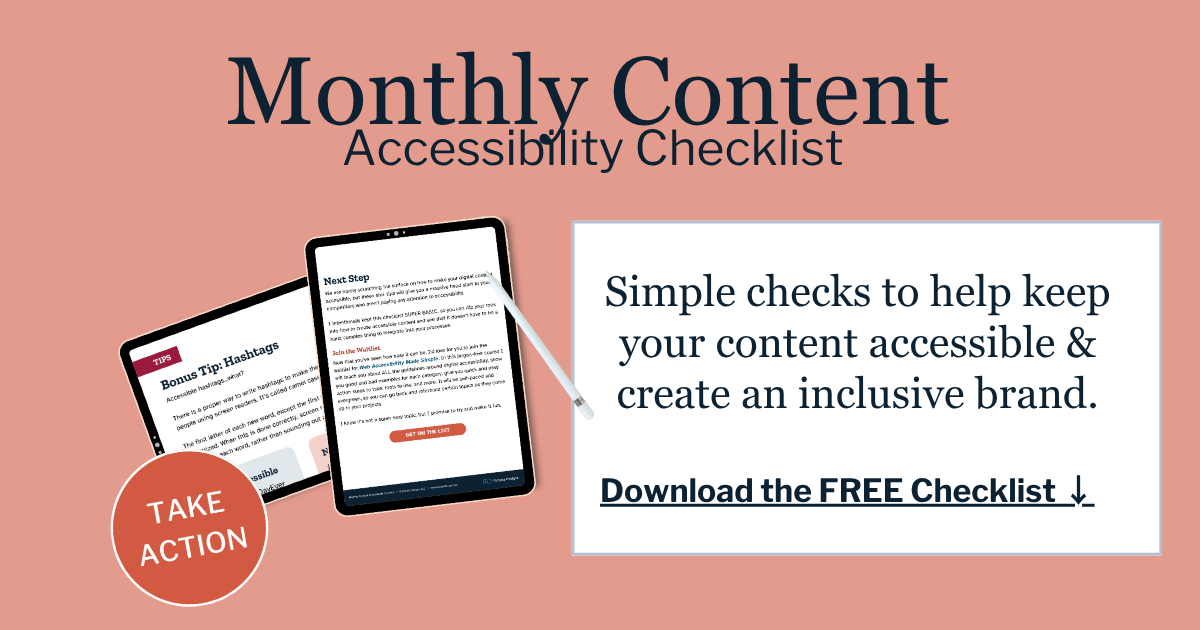
Website Accessibility Checklist for Copywriters
Before sending website copy to the client, designer, or developer, review these questions:
Does the page title clearly describe the main topic?
Do the headings explain what each section contains?
Have I clearly marked the page title, main sections, and subsections in the draft?
Do links and buttons identify their destination or action?
Can repeated link or button labels be told apart?
Does the wording fit the knowledge and needs of the intended audience?
Are unfamiliar terms and acronyms explained where needed?
Are paragraphs and sentences divided into manageable ideas?
Is important information from graphics also included as website text?
Have I flagged images that may need alt text or a longer description?
Is a specific transcript link included when a page contains video or audio?

We helps small businesses build websites that are accessible, clear, and easier for EVERYONE to use from the start. If you want a professional review of your site’s accessibility, we’d love to take a look.
Accessible CopyWriting FAQs
How can copywriters make website content more accessible?
Copywriters can write specific headings, use descriptive link and button labels, organize information in a logical order, explain unfamiliar terms, write clear instructions, and identify content that may need an image description or transcript link.
Do copywriters need to know WCAG?
Copywriters do not need to become technical accessibility specialists, but it helps to understand the content-related basics. Familiarity with headings, link purpose, instructions, image information, and transcripts can prevent common problems before handoff.
Should copywriters write alt text?
It depends on the project. Some copywriters write or review alt text, while others do not choose the images or work inside the website. At minimum, they can flag when an image contains important information that should also be available in text.
What should a copywriter do when a page includes a video?
The copywriter can introduce the video, explain what it covers, and include a clearly labeled link to its transcript. Captions, audio descriptions, and media editing are usually handled by other members of the team.
Can accessible content writing support SEO?
Clear page titles, useful headings, descriptive links, and organized content can support search visibility while also making the page easier for visitors to use. Accessibility should still be approached as a way to provide equal access, not only as a search tactic.